Showing posts with label Reformed Theology. Show all posts

Monday, June 9, 2014

Geerhardus Vos' 5-Volume Reformed Dogmatics May Surprise You


Geerhardus Vos wrote his Reformed Dogmatics in Dutch, by hand, in 1896. Fourteen years later some unknown individual transcribed Vos’ work into print in Dutch. For the last 103 years this printed work has been inaccessible to theology students who never got around to learning Dutch. It is to the high praise of Logos Bible Software that this important work of Reformed theology is now being made available in English. At this point, only the first volume, encompassing Doctrine of God proper and the first 80 pages of the second volume, dealing with Anthropology have been made available to those who have purchased this set.

Vos’ Reformed Dogmatics holds two big surprises for its readers in terms of its clarity and its format.

As to the first surprise: the book’s clarity. Amongst my fellow seminarians the name Geerhardus Vos conjures up impressions of great, rich biblical theology. But it also brings memories of a borderline incomprehensible writing style. Those who have read Vos’ Biblical Theology or his seminal Pauline Eschatology may relish the opportunity to learn once again from the master. They may not, however, be too excited about actually reading it, as Vos doesn’t have a reputation for being the most lucid of writers.

Because of this reputation, right out of the gate, the greatest delight I had from reading Reformed Dogmatics was in the undeniable clarity of the writing and argumentation that Vos employs. It is common to think of Vos as primarily a biblical theologian. His most important works that have been published so far have been in this vein. But the simple clarity of Reformed Dogmatics causes me to wonder if his true passion might have been in the systematics courses that he taught for so many years.

I am quite certain that Richard Gaffin deserves much of the credit for his work on the final form of the translation. I know that Dr. Gaffin is experienced at translating from Dutch into English, and his skills are put to excellent use here.

The second surprise of Reformed Dogmatics is its format. The book is not written in a traditional way (as one might find in say, Calvin’s Institutes or Bavinck’s own Reformed Dogmatics. Instead, the book is written in a question-and-answer format more similar to Turretin’s Institutes. At first I was distressed by this, feeling initially that I was reading class notes or scraps of ideas. This is thankfully not the case. When Vos gives a brief answer, it is welcome. And when he gives long answers it is because a lengthy case needs to be made. The format is welcome because it contributes to a sense that the answers have been carefully organized. I quickly grew used to it.

If I was to make one complaint (and this would be minor) it is that many of the questions that Vos raises are not symmetrical. There is something thoughtful and thorough about the sorts of questions that Turretin raises in his Institutes that seem to be missing in Vos’ own work here. This means that some subjects seem to be covered a bit more thoroughly than others. As an example, Vos asks the question, “How do you refute Sabellianism?” and he gives a four-part answer that is succinct, well organized, and exceedingly helpful. But there is no similar question for the converse error of Sebellianism—in this case Tritheism. This may be because tritheism simply is not a realistic option, but neither should Sebellianism be. In a systematic treatment, I do think that addressing this question would have made sense.

Vos was slightly younger than Herman Bavinck, whose own Reformed Dogmatics we know all too well. It seems that Vos’ discussions of numerous loci of theology (especially divine passibility and atemporality) line up very happily with those of Bavinck. If Bavinck reflects the mainstream of Dutch theological thought it would appear that Vos reflects a similar approach to theology, albeit with a different didactic method. Many students I have talked to find Bavinck’s discussion of some issues hard to follow, as he spends much time talking about other views before he gets to discussing his own view. In this respect Vos presents a contrast to Bavinck in terms of his brevity and clarity.

It is my hope that support and interest in Vos’ Reformed Dogmatics will continue to grow in the Reformed community. I am enthusiastic to have the guiding voice of Geerhardus Vos added to discussions not only of Biblical Theology but Systematics as well. It is a subject which Vos taught for many years and one which those of us who were not his students firsthand now know he was ably suited to.

Monday, February 24, 2014

Book Review: From Heaven He Came and Sought Her

I have a confession to make. I might have been the worst arminian in the history of arminianism. Long before I knew what Calvinism was, and long before I’d ever heard of TULIP, I believed in a form of definite atonement (DA). I had reasoned that if God knew who was going to believe and who wasn’t, that Jesus must have only borne the sin of those he knew would eventually believe, otherwise hell would be populated with atoned for and forgiven people. Furthermore, I believed that Jesus’ prayer in the Garden for those who would eventually believe meant that he planned to only die for them on the cross. The difference between then and now is that I believed God’s knowledge of believers was based on a passive foreknowledge, not on any sort of decree. It was a terribly sloppy soteriology, and I had no worked-out doctrine of atonement to help me make sense of it all, but I do think this admission means I might have been the worst Wesleyan-Arminian that ever existed.

Many new Calvinists struggle deeply over the question of the atonement: was it universal, with the intention of trying to save all mankind, or was it specifically intended to redeem the elect? For me, this was a relatively inoffensive doctrine once I came around to the other four points of the beautiful flower of Calvinism. I found the idea of atoned for and forgiven people burning in hell be a far more unthinkable and offensive doctrine.

The editors of this present volume define definite atonement as follows: “in the death of Jesus Christ, the triune God intended to achieve the redemption of every person given to the Son by the Father in eternity past, and to apply the accomplishments of his sacrifice to each of them by the Spirit” (33).

In some ways its difficult to review From Heaven He Came and Sought Her (FHHCASH). The book is 700 pages, with 23 chapters written by 21 authors, each organized under one of four areas of interest. Part I is geared towards addressing historical concern in relation to DA. In Part II nearly 200 pages are devoted to addressing DA in regard to specific Scriptures. Part III is intended to deal with the systematic issues related to DA. Finally, Part IV of the book deals more closely with DA from the perspective of evangelism and pastoral care. The difficulty of reviewing stems from the variety of authors, the sheer number of chapters, and the fact that this is a blog post, not a theological journal that can run 30 pages in length and detail every argument. In the end, readers will have to forgive my brevity and resistance to summarizing every chapter.

All in all, I think that the editors plotted the map well when they considered the structure of such an ambitious book. One need only look at the Table of Contents to get the impression that the editors tried to cover definite atonement from as many relevant angles as could be done. My first impression of FHHCASH was to think of this as an introduction to definite atonement, which was a mistake. While there are certain chapters I would direct someone to if they wanted to understand the issues, the book can get quite complex towards the middle (as it should, for such an important issue). With regard to beginners, if one begins even with chapter 1, they will find that the authors assume a certain familiarity with the subject on their reader’s part. It is in that sense that I would probably recommend a neophyte begin at the end of this work; particularly the last two chapters. One of those chapters is by Sinclair Ferguson and addresses pastoral issues related to assurance and what bearing DA might or might not have on it. The other chapter is by John Piper and deals with the larger scale question of what bearing the truthfulness of DA has on the chief end of the church to glorify God and enjoy him forever.

One of the most important questions I asked myself while reading this book was whether the arguments of hypothetical universalists were being represented fairly. The authors are quite conscientious about using actual arguments from actual theologians with opposing viewpoints. Men such as Amyraut, John Davenant, John McLeod Campbell, Karl Barth, Bruce Ware, and Mark Driscoll are names that frequently come up throughout. They are quoted extensively and the authors seem to fairly engage with their viewpoints. I have read some reviews where others have said misrepresentations and caricatures are used in the more polemical sections of this book. The places where that may happen is in those sections where general perspectives (I'm thinking of a few places in Letham's chapter that stand out in my memory) are engaged with and not specific authors. I understand this temptation, but thankfully most of the polemics in this book are dealing with the actual views of actual theologians whose books are actually in print.

I already stood persuaded that definite atonement is taught in Scripture before I read this book. I am not an unbiased reviewer. That being said, I think this will probably become the book that opponents of DA will need to interact with in the future. Primarily, I think this is because From Heaven He Came and Sought Her engages with the best opponents of DA in a way that (I think) is fair, rigorous, comprehensive (in its scope), and pastoral.

Will the collective argument set forth in FHHCASH persuade those who hold to hypothetical universalism? Certainly not all of them. I know a few proponents of HU who are reading this book now, and I am quite eager to see how they interact with FHHCASH, and especially to see if they feel their best works were fairly engaged by the various authors.

If you already believe in DA, is there any reason for you to read this? I can think of a few ways that this book will function for those who have already come over to the good side of the force:

  1. You will come away from this book with a more robust understanding of Hypothetical Universalism. It’s more sophisticated than most of us give it credit for! It may surprise some of you to know that defenders of HU do more than just quote John 3:16 until their heads fall off.
  2. 
You will come away from this book with a more robust understanding of Christ’s work on the cross.
  3. As you're reading this book you will probably find yourself worshipping the God who has perfectly purchased and atoned for his people. If you don’t then you’ve got some ice-cold blood running through those veins.
  4. 
You will have a future resource for thinking about “problem texts” (we know they’re there!) that defenders of definite atonement need to be prepared to discuss.


I loved the book. I knew I’d love it before I read it based on other reviews, the blurbs, and the hype. There are weak(ish) chapters (Hogg and Haykin), there are truly informative chapters (Djaballah’s chapter on Amyraut—whose works are only available in French stands out, along with the chapter by Gattis on the debates at Dordt), and then there are chapters that are absolutely essential reading (Letham, Motyer and Garry Williams). Even the relatively “weak” chapters here are still important reading and helpful, but if somebody is going to browse the book and read some things and not others, I would make sure that Motyer’s chapter and Letham’s chapter receive their special attention.

As I said before, I strongly suspect this will become the go-to resource for years to come with regard to definite atonement. Believers in DA will find their appreciation of the atonement reinforced by this book. Opponents of DA will find numerous sparring partners here as well. The Gibson Brothers have done a great service to the church by editing this volume. Also, it’s officially the prettiest book that I own.

Amazon Hardback
Amazon Kindle

Saturday, January 5, 2013

Eleven Theses Actually on Natural Law

Adam Parker and I have composed this humble attempt at a response/critique/polemic to this post.

1. Natural Law is not to be equated with what people have said about natural law. The writings of John Rawls, for example, are not natural law. However, just because people differ about what is contained in natural law does not mean that natural law is deficient; the problem is with its interpreters.

2. Affirming natural law does not require a nature/grace dualism, simply because some who hold to natural law affirm this dualism. Luther and Calvin believed in natural law, and they were not friends of such a dualistic conception.

3. If someone accepts the reality of natural revelation, they would also need some doctrine of natural law. Natural revelation is a clear enough source, in and of itself, for what it is intended to reveal, and although it can be supplemented by other revelation, it does not have to be in order to be properly understood. Natural law is perspicuous, otherwise it would be unjust to condemn someone on the basis of it.

4. The God who speaks through nature speaks in Scripture, and the God who speaks in Scripture was born of a virgin in Bethlehem, but do not forget, God still speaks clearly through nature.

5. Those who accept natural law in this sense do believe that natural law can operate independently of special revelation because special revelation is consistent with natural law. The God who speaks in natural law, who was born of a virgin in Bethlehem, is the same God who spoke through Moses, the prophets, and the Apostles and thus speaks with one voice.

6. Every Christian who affirms natural law, by definition, must also hold to the exhaustive authority of Jesus over every last molecule.

7. If a person rejects natural law in all its formulations, but insists that special revelation is authoritative over the public square, this is a serious error.

8. The most serious dualism to avoid is not a nature/grace dualism, but rather the dualism that tries to pretend that God speaks with a forked tongue in special and natural revelation, as though one trumps the other.

9. The list given in Romans 1:29-32 confirms that natural law provides a rather extensive amount of detail when it comes to what God will judge. Natural law contains considerable detail that can be known on the basis of natural revelation alone. Natural law communicates these things, regardless of what special revelation says about it.

10. The Reformers held to a robust form of natural law theory.

11. It can be demonstrated that natural law prohibits homosexual marriage.

Saturday, June 2, 2012

Why It Is a Blessed Thing That The Fall Happened

In one of his sermons ("East of Eden"), Jonathan Edwards spends time briefly reflecting upon the blessedness of Adam (if he had obeyed God and been confirmed in righteousness).  He then spends some time talking about why we, as fallen creatures, experience greater joy and blessedness than if Adam had never fallen.  "But there are many things that greatly contribute to the happiness of those that are saved that Adam, if he had stood, would not have had."  I'll bullet-point Edwards' seven things:

1. Saints have union with Christ to enjoy, which they would not have enjoyed if Adam had not fallen.
2. Because of their union with Christ, "they also enjoy nearer relation to God the Father, and are partakers of a greater love of the Father."
3. Christ's obedience, Edwards argues, is a more glorious obedience than Adam's would have been, and therefore was "rewarded with a better reward."
4. Because of their redemption, Christians also share in Christ's exaltation on his throne, "which was the reward of his mediatorial righteousness."
5. Edwards argues that Christians have a more intimate knowledge and enjoyment of God, since Christ was incarnated: "he has taken upon him the human nature and so is nearer to them."
6. We experience a higher manifestation of God's love in Christ.  "This will make all their enjoyments and blessedness the sweeter, the consideration of their being the fruits of such a wonderful love and grace."
7. Finally, Edwards says that as a consequence of the Fall, the redeemed "will have a greater manifestation of the glory of God, God having taken occasion from the fall of man to make a more wonderful display of his glory in the work of redemption. And the more is seen of the glory of God, the greater advantage is there for happiness in the contemplation of it."

Notice the decidedly God-centered character of these answers.  It's just another thing which makes Edwards such an admirable thinker, worthy of emulation.

Thursday, May 31, 2012

For the Reformed Among Us

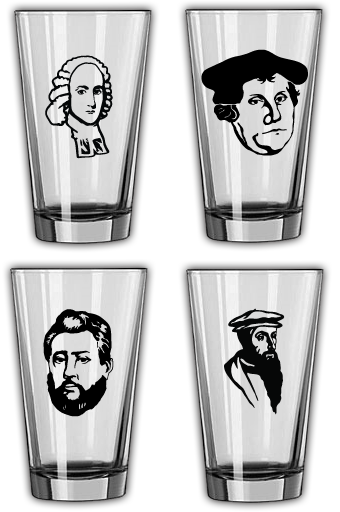
I came across these great pint glasses the other day and thought I would pass it along to our readers. They can be purchased here and would make a wonderful gift for Adam (or me).


Tuesday, May 22, 2012

Homosexuality, Tattoos, and Ceremonial Laws

From Twitter:

Tattoo of Leviticus 18:22 forbidding homosexuality: £200. Not knowing that Leviticus 19:28 forbids tattoos: Priceless.
The world is full of people who choose to misunderstand the moral claims that Christians make.  However, it is also full of Christians who come by their ethical views through faulty methodology.  Christians do not (or at least should not) believe that homosexual activity is wrong primarily because of the fact that it was forbidden in Leviticus.  We believe it is wrong, first, because of the Scriptures' positive teachings on what is good, what is right, and how God created human beings to live.  This goes back to the original good creation before the fall when God instituted marriage and created a woman specifically for the man and called it good.  Jesus affirmed the goodness of the original creation and the goodness of marriage in Matthew 19:5 when he stated what marriage is: "He who created them from the beginning made them male and female and said, 'Therefore a man shall leave his father and his mother and hold fast to his wife, and the two shall become one flesh.' "

The Christian ethical position on homosexual behavior (which has been unwaveringly consistent) is rooted first in God's will, it is evident to all via the natural law and then further confirmed by what we find in the Scriptures, but these are things which have been so from the beginning.  The question of what place Leviticus 19:28 still holds in terms of the moral law and whether it is part of the moral law or the ceremonial law is a worthwhile discussion, but even if Leviticus 18:22 is in the same book as other laws which are no longer binding is not debatable.  It absolutely is.  However, the basis of the belief that the ceremonial laws and laws of uncleanness have been revoked is, in part, Acts 11, where Peter received the revelation of God which separated the Jewish and Gentile Christians by the ceremonial laws of cleanness and uncleanness.  There are reasons why Christians can eat cheeseburgers and orthodox Jews won't get near the stuff.

There is no doubt that many laws in the OT were revoked, and it could very well be that tattoos are part of that.  Either case, I congratulate King Cogidubnus on a well-placed punch.  That's funny stuff.  I love irony as much as the next fella, which is why I try to always read Romans 12:1 while eating a Baconator.

Monday, May 7, 2012

A Perfect Version of The Reformed Creeds?

Have you ever thought to yourself, "Gee... I like my hardbound Westminster Standards, and I also like my hardbound copy of the Three Forms of Unity, but I sure would like them all together in one volume, and I'd sure like to be able to lay them out flat on the table without laying an encyclopedia along the top edge so it will lay open flat"?

If so, I present to you my favorite new copy of the Ecumenical and Reformed Creeds and Confessions:


It won't win any awards for sexiness.  Steve Jobs won't sing your praises from the grave for the beauty of its design.  However, it is amazing.  Gaze upon its beauty.


As if the always-lays-flat design weren't already extremely useful, check out the tabs on the side allowing you to quickly load your weapon of choice.


This particular print is printed at Mid-America Reformed Seminary and been around since 1991, so I'm hardly the first person to own this.  However, I've found it hard to believe that people have not been singing this volume's praises from the mountaintops before now.


It has a preface by Nelson Kloosterman, and it contains The Apostles' Creed, The Nicene Creed, The Athanasian Creed, The Form of Subscription, The Belgic Confession, The Heidelberg Catechism (with Scripture proofs), The Canons of Dort, The Westminster Confession, The Larger Catechism, and the Shorter Catechism.


There is only one downside, and that is the absence of scripture proofs in the Westminster Standards section.  Such would have been invaluable for devotional reading purposes.  However, these are small qualms considering the richness of this volume.  It is not perfect, but it is... nearly perfect.  I commend it to you, and I wish to thank Dave Alexander from my church for giving this to me.  He saw how much I admired it and gave it to me out of grace and kindness, from one brother in the Lord to another.

You can find this copy of the Reformed Creeds here.

Friday, January 27, 2012

Brenz on the Gospel


By nature human beings are made in such a way that they do not want to accept anything from God free of charge but want to earn it by their works and their righteousness. It is diabolical arrogance not to want to get anything from God free of charge but to earn everything, because this is saying that we want to be God ourselves. This is what Adam began in the garden and from there it has spread to the entire human race. 
Admittedly there is a danger in teaching justification by faith to people who are rebellious and despisers of religion. But just because there is a danger in doing this, it does not follow that the church should be deprived of what is necessary for its salvation. There is danger in producing wine, because people get drunk on wine. Yet God has created wine, which is healthy if used in the right way... No work of the moral or ceremonial law can justify us in the sight of God because no work can be done by us with the degree of perfection and integrity that would be needed for God to accept it. All our good works are imperfect and corrupt. Therefore they cannot justify us... When it is said that the Gentiles are not justified by the works of the law, this does not mean that good works that are moral or part of the natural law are not to be encouraged. Of course the natural law must be observed, and anyone who does not follow it is ungodly and worse than an infidel. What it means is that the merits of our good works have no validity in the judgment of God, nor do they delivery us from the sentence of condemnation. So we must do the works of the natural law but not think that they can save us from perishing or acquit us before the judgment seat of God. There is another kind of righteousness, namely the righteousness of Christ, which is perfect and which is received by faith.


Johannes Brenz, from The Reformation Commentary on Scripture, Galatians, Pg. 70-71

Sunday, July 31, 2011

Two Quotes from Calvin on Natural Law & Civil Laws

[T]here are some who deny that a commonwealth is duly framed which neglects the political system of Moses, and is ruled by the common law of nations. Let other men consider how perilous and seditious this notion is; it will be enough for me to have proved it false and foolish. (IV.XX.14)
Now, since that last quote is a bit of a tongue-twister, I thought I would restate it in a way that reads like English. So here it is - Adam's paraphrase:
If you don't think that a good nation should be ruled by the common law of nations and instead you think that a good nation's laws must include the Mosaic law, you are a dummy.
I didn't say it - Calvin did! (I didn't say it would be a kind paraphrase.)

In the next section, Calvin discusses the importance of Equity.
We [should examine]...these two things: the constitution of the law, and the equity on which its constitution is itself founded and rests. Equity, because it is natural, cannot but be the same for all, and therefore this same purpose ought to apply to all laws, whatever their object. Constitutions have certain circumstances upon which they in part depend. It therefore does not matter that they are different, provided all equally press toward the same goal of equity.
It is a fact that the law of God which we call the moral law is nothing else than a testimony of natural law and of that conscience which God has engraved upon the minds of men. Consequently, the entire scheme of this equity of which we are now speaking has been prescribed in it. Hence, this equity alone must be the goal and rule and limit of all laws.

Whatever laws shall be framed to that rule, directed to that goal, bound by that limit, there is no reason why we should disapprove of them, howsoever they may differ from the Jewish law and among themselves. (IV.XX.16)
You'll have to forgive all of the Two Kingdoms posts. That's what I've been studying and reading about lately; ergo... lots of 2K discussions. Or maybe I've just been looking for lots of excuses to Photoshop humorous images of Calvin onto other peoples' bodies...

Friday, July 22, 2011

Manata on Free Will, Moral Responsibility, and the Reformed Tradition

Paul Manata has written a paper discussing the subject of Free Will and Moral Responsibility, especially focusing on the Reformed tradition. Much to my delight, he spends some time interacting with so-called "Reformed Libertarianism," which Richard Muller seems to see within the Reformed tradition. Much of my satisfaction with Manata's interaction in this respect touches on the fact that I had some brief thoughts awhile back regarding Muller's reading of Jonathan Edwards as creating a divergence within the Reformed schools of thought on this very subject.

I am currently celebrating my tenth wedding anniversary with my wife and have not, as of yet, had an opportunity to read Manata's paper on the subject, but I am looking forward to the coming days when I will get to see how Manata interacts with both theologians past, as well as theologians present. You can find Manata's paper at his blog: here.

Monday, April 25, 2011

What is Monergism?

In the comment section of this post, Evan posted a link to an article by a Roman Catholic on monergism. This article starts off by offering a definition of monergism.
Monergists, i.e. Calvinists and some Lutherans, claim that man cannot cooperate with God in salvation, because that would detract from God’s glory.
And this is where the problem begins. The Reformed (and Lutheran) understanding of monergism is particularly concerned with regeneration, and not all of salvation. A simple look at the five solas of the Reformation should make this clear, one of which is sola fide or "by faith alone." The Reformers taught that believers must have faith to be saved. This is something the believer does. Granted, faith is a free gift from God and it is not meritorious in any sense, but it is still something that the believer does. In regeneration, on the other hand, the believer is completely passive. In other words, regeneration is something that happens to the believer and the believer does nothing for it to happen. In John three Jesus likens the new birth with the first birth. So, just like a baby is born without doing anything, so too a Christian is born again (i.e., regenerated) without doing anything.

Monergism.com defines monergism as: "In regeneration, the Holy Spirit unites us to Christ independent of any cooperation from our unregenerated human nature." Notice there is nothing about salvation as a whole. I think the problem here might be with the term "salvation." This term can refer to an aspect of the total work God does in the elect (i.e., justification) or the whole of God's work. In theological discourse, however, especially when critiquing another view, a person ought to be a careful as possible and offer the best the other side has to offer, not the worst. It is easy to pick the low hanging fruit off a tree. Thus, by confusing the terms salvation and regeneration, our Roman Catholic blogger is able to make the Reformed faith seem unbibilical, when in fact the view he is interacting with is not the Reformed view at all. He would benefit from a better understanding of the view he is attempting to decry. Straw men are easy to knock down, I guess that is why theologians enjoy building them.

Tuesday, April 19, 2011

Twin Lakes Audio

The audio from Twin Lakes Fellowship has been posted here. Of note are: 1) the sermon by Derek Thomas on adoption in 1 John 3:1-5, here; and 2) the interview with Sinclair Ferguson, here.

Friday, March 11, 2011

Zanchi on Divine Causality

But since God by His providence doth preserve second causes which He useth in governing the world, everyone in her proper nature, yea, and is the mover of them--and of them, some are ordained of their own nature to certain and sure effects, and other some [others] are indefinite--we know and confess that although in respect of God, without whose foreknowledge and will nothing can happen in the world, all things are done necessarily (Matt. 10:29-30). Yet in respect of us, and of the second causes, many things happen and come to pass chanceably [by chance]. For what can be more chanceable [?] and casual, to a carpenter and travailer [traveller ?] than if the ax fall out of his hand and kill the other (Ex. 21:13)? Yet the Lord saith [sayeth] that it is he which killed the travailer [traveller]. And our Lord Jesus died willingly; yet He said, Christ must suffer (Luke 24:46). Herod and Pilate, of their free will, condemned Jesus; yet the apostles say they did nothing but what the hand and counsel of God had decreed to be done (Acts 4:28).
Jerome Zanchi
Confession of the Christian Religion
Chapter 6, Section 5

Sunday, February 27, 2011

Measuring Our Response to Rob Bell

After Justin Taylor shared his post "Rob Bell: Universalist?", I was immediately ready to throw the good book at Bell. Believe me; I'm as eager as the next guy to condemn Rob Bell for being a false teacher - if, in fact, that is what he is.

The problem, as I see it, is that while at first I saw no ambiguity in the book's blurb (which you can read at JT's blog), and while at first I saw no ambiguity in the video that accompanies the blurb, I have since changed my mind.

You see, the only definitive statement I can find from Bell in all of this is that:
  • "[A] loving God would never sentence human souls to eternal suffering."
If this were a heresy trial, I'm not sure that the verdict would be guilty, simply based on this one line. The problem with hanging our hat on this sentence is that Bell may, in the end, be taking the line that "God isn't sending people to Hell - their sin is."

LOVE WINS. from Rob Bell on Vimeo.


Someone might argue that his rhetorical flourish regarding Ghandi's presence in Hell is likewise an indicator that he is outright denying the biblical teaching on Hell. The problem is, there's still wiggle-room. He might be questioning the presumptuousness regarding one's attitude toward the eternal fate of another when, in fact, we don't really know. As an example of the type of wiggle-room that might be going on: "You don't know about Ghandi's soul; maybe he was saved before he was assassinated" or something like that.

The video itself certainly looks definitive at first glance. But it is composed of 95% rhetorical questions. Typical Emergent stuff - you know, questions are the only real answers (blah blah blah). Anyway, it has certainly been presented to make Bell look like he denies that any are damned; but there are a lot of possibilities here about what is really going on. He could be an annihilationist (which we must grant is awful, but still not the same thing as universalism). He could be a pluralist (i.e. John Hick). He could have some sort of Barthian universalism in mind ("God's 'yes' is stronger than man's 'no.' "). He could just straight up believe that Jesus died for every man, and that thus every man will be saved (true universalism). And of course, there are a host of other horrifying possibilities as well. The possibilities are so varied that I would be embarassed to go on record about this until we know more, although the second we know what is really being taught, we can get to work picking apart, critiquing, and condemning, if necessary.

Part of my reaction here is that I have many friends who are diehard Rob Bell fans - they listen to all of his sermons and read his books. I asked them point blank what they have heard the man teach on the subject of Hell. They told me that he has taught on heaven and hell before and that he most definitely did not teach from a universalist perspective, so all of this is very surprising to them. As such, this book would represent a watershed moment in Bell's constant theological development. Considering that universalism is not in line with his past teachings on the subject, I think that charity may be the best approach until we know what sort of theology he's actually going to be presenting.

It may be that everything is as it seems, and Rob Bell has, in fact, outed himself and abandoned the faith once delivered. But I am one of those voices who is patient enough to wait a month and see what's really going on. The alternative is, he ends up not being a universalist, based on the possible loopholes I just presented, and we Calvinists and Reformed-types end up looking like the caricature that has been created for us - judgmental, knee-jerk, irrationally paranoid and the like. I don't think those caricatures are fair or accurate, but we could be playing right into them if we aren't measured and cautious in our response to Bell - especially considering that this is a life-or-death, heaven-or-hell issue. Literally.

At the end, the point of this post is simply: it may be wise to wait until Rob Bell's new book comes out and we read it before we consign him to the Hell he might be denying.

Friday, February 25, 2011

Having Been Justified...You have Hope

In his excellent commentary on Romans, Tom Schreiner makes some thoughtful comments on Romans 5:1-5 and the christians hope.
Three consequences of righteousness are articulated: peace, access to grace, and hope. The last receives the greatest attention in the text (vv. 2b-5), validating my contention that hope is the central motif in the text. Paul argues that hope is strengthened even in afflictions since a chain of effects occurs when trouble strikes: troubles beget endurance, endurance produces tested character and the result of tested character is hope. Contrary to hope in this world, this hope will not bring shame on the day of judgment because the experience of God's love in the present thought the Holy Spirit demonstrates infallibly that believers will not experience God's wrath on the last day.